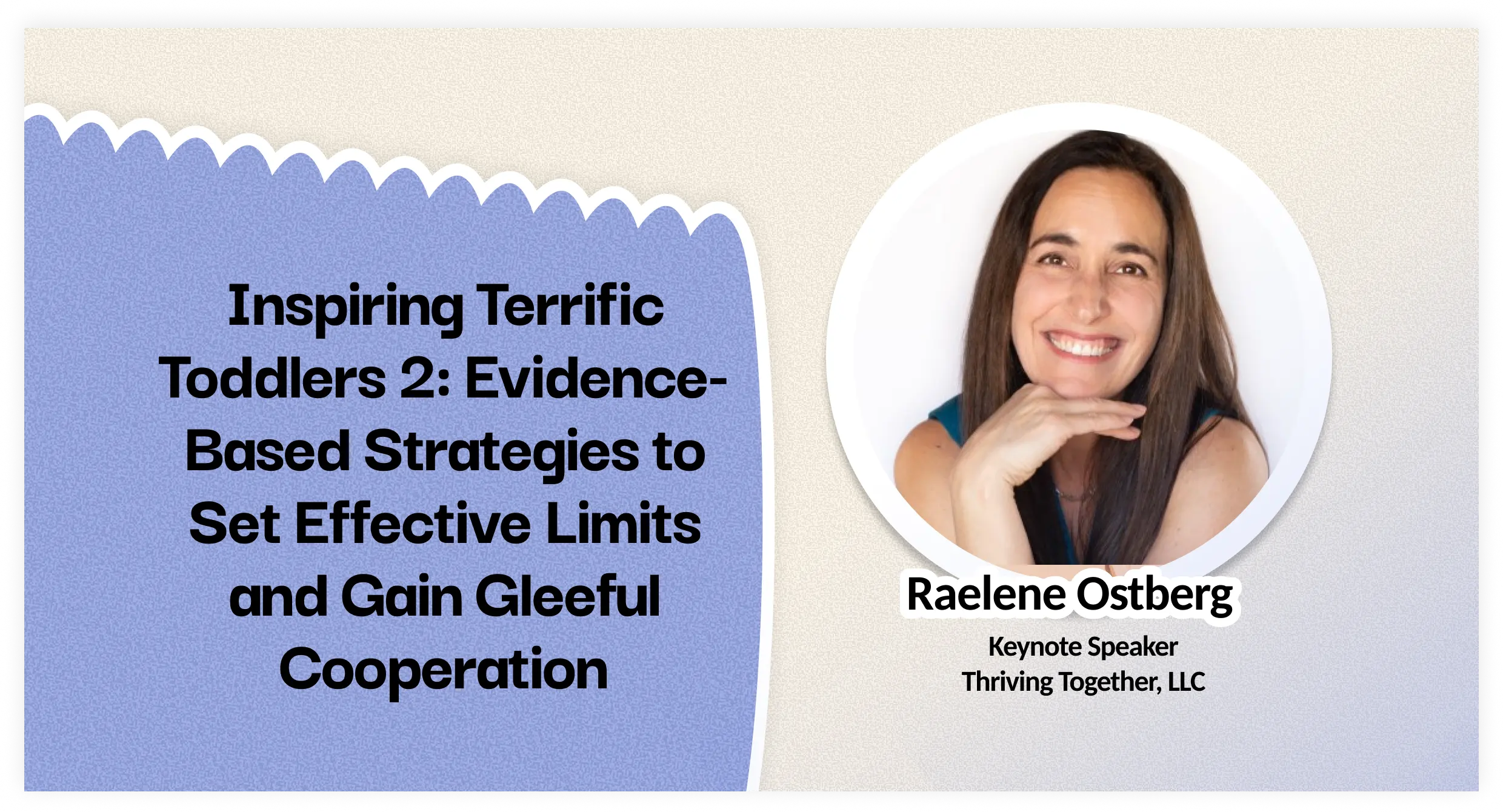
Inspiring Terrific Toddlers 2: Evidence-Based Strategies to Set Effective Limits and Gain Gleeful Cooperation by Raelene Ostberg
2 PM - 3:30 PM EST
Register for link

Resources
About this webinar
Toddlers are curious, energetic, and driven to explore their world. They want to touch, test, try, and do things for themselves—and that powerful developmental drive can make following adult directions a challenge. Why don’t toddlers simply listen when adults tell them what to do? Why do familiar prompts like “walking feet” or “gentle hands” sometimes seem to go in one ear and out the other? And what can adults do differently to help toddlers understand limits, follow an adult’s lead, and reduce refusals?
In this engaging and practical session, participants will examine why common adult prompts may not work as intended and how small, playful shifts and positive communication techniques can meet toddlers where they are developmentally while still maintaining clear and effective limits.
Participants will explore four toddler-specific strategies that align with how toddlers think and learn: be contrary, be silly, be naïve, and be fun and apply them to common difficulties. Through relatable stories and real-life examples, educators will examine how these approaches can help toddlers understand expectations, move beyond their internal drive to “do it myself,” and become more willing and able to follow an adult’s lead.
Educators will leave with practical, developmentally appropriate strategies they can use immediately to reduce power struggles, increase cooperation, and make everyday interactions with toddlers more positive and joyful.
Rationale: Toddlers’ strong emotions, emerging independence, and developing self-regulation can create challenging moments for even the most experienced educators. While understanding toddler development is essential, caregivers also need practical, evidence-informed strategies for responding effectively when children test limits, resist directions, or engage in behaviors that adults find challenging.
This session addresses the need for developmentally appropriate guidance approaches that help educators move beyond repeated reminders, power struggles, and reactive responses. Participants will explore practical tools for setting clear limits, communicating expectations, and supporting toddlers’ growing independence while maintaining strong, trusting relationships.
By equipping educators with strategies that work with the toddler brain rather than against it, this session can help reduce stress, increase educator confidence, and create more positive learning environments for toddlers and the adults who care for them.
By the end of this session, participants will be able to:
Explain how toddlers’ developmental drive to explore, test limits, and assert independence can influence their ability to follow adult directions and contribute to power struggles.
Identify at least two factors that may prevent a toddler from understanding or responding to an adult’s communication.
Apply at least two developmentally appropriate guidance and communication strategies to help toddlers understand limits, increase cooperation, and successfully follow an adult’s lead.
Upcoming Webinars
Website-First Marketing: The Simple Marketing System Every ECE Program Needs to Grow Online by Chelsea Denny
Oct 14, 2026

From First Tour to Long-Term Loyalty: Designing the Family & Staff Lifecycle Journey by Melissa Blotter
Oct 15, 2026

Preschoolers and Pixels by Amy Reyes-Hauff, CDHP
Oct 21, 2026

Our Voices Across Generations: AANHPI Educators in Early Childhood Education Panel
Oct 28, 2026

Monthly Live Demo: See How Playground Streamlines Your Program
Nov 3, 2026

The Enrollment Hot Seat: A Live Marketing Workshop with Three Real Child Care Programs by Bruce Spurr
Nov 3, 2026

Boundaries vs. Requests: Setting Limits Without Escalation by Alyssa Blask Campbell
Nov 4, 2026

HuUbuntu: I Am Because We Are - Way of Life by Dr. Patrick Makokoro
Nov 5, 2026

Enrollment Playbook: Policies, Handbooks and Growth
Nov 10, 2026

Inspiring Terrific Toddlers 1: Why Do They Do That? Promoting Toddler Development to Reduce Frustrating Behaviors by Raelene Ostberg
Nov 11, 2026

Compliance Without the Chaos: How to Keep Your Program Inspection Ready
Nov 17, 2026

When to Say When: Building Confidence in Supporting Neurodivergent and Developing Minds Part II: Direct Guidance, by Michele Hemenway Pullen
Nov 18, 2026

This is Your Brain on Fairytales: Storytelling, Neuroscience, and Connecting the Dots in Early Childhood by Stephanie Goloway
Nov 19, 2026

Hyperlocal Marketing: Turn Community Connections into Child Care Enrollment by Kate Woodward Young, M.Ed. and Carrie Casey
Dec 1, 2026

Talk, Play, Read, Sing: The Language Nutrition Approach to Creating Powerful Language Environments for Young Children by Jennifer Adams Oppenheimer
Dec 3, 2026

Ready for 2027? Need an Assistant? Let AI Help You Work Smarter by Monique Reynolds
Dec 8, 2026

Inspiring Terrific Toddlers 2: Evidence-Based Strategies to Set Effective Limits and Gain Gleeful Cooperation by Raelene Ostberg
Dec 9, 2026
Through the Child’s Eyes: Creating Responsive Classrooms Through Observation, Interaction, and Belonging by Lori Kowit, M.A.
Dec 10, 2026

Pause, Ponder, Play: The Power of Time in Nature-Based Learning by Dr. Rachel Larimore
Dec 16, 2026

Learning Beyond the Fence: Safe and Meaningful Nature-Based Learning Outside the Fenced Play Area by Dr. Rachel Larimore
Jan 20, 2027
Frequently Asked Questions
How do I earn an official certificate?
Are there any prerequisites for attending a webinar?
Do you provide CEUs?
What is the format and learning environment of your live webinars?
How much does it cost to register for or attend a webinar?
How can I access an on-demand recording?
Can I earn a certificate by watching a recording?
How do I earn a certificate of attendance?
If I'm attending with a group, can we all earn a certificate of attendnace?
Free Certificates of Attendance
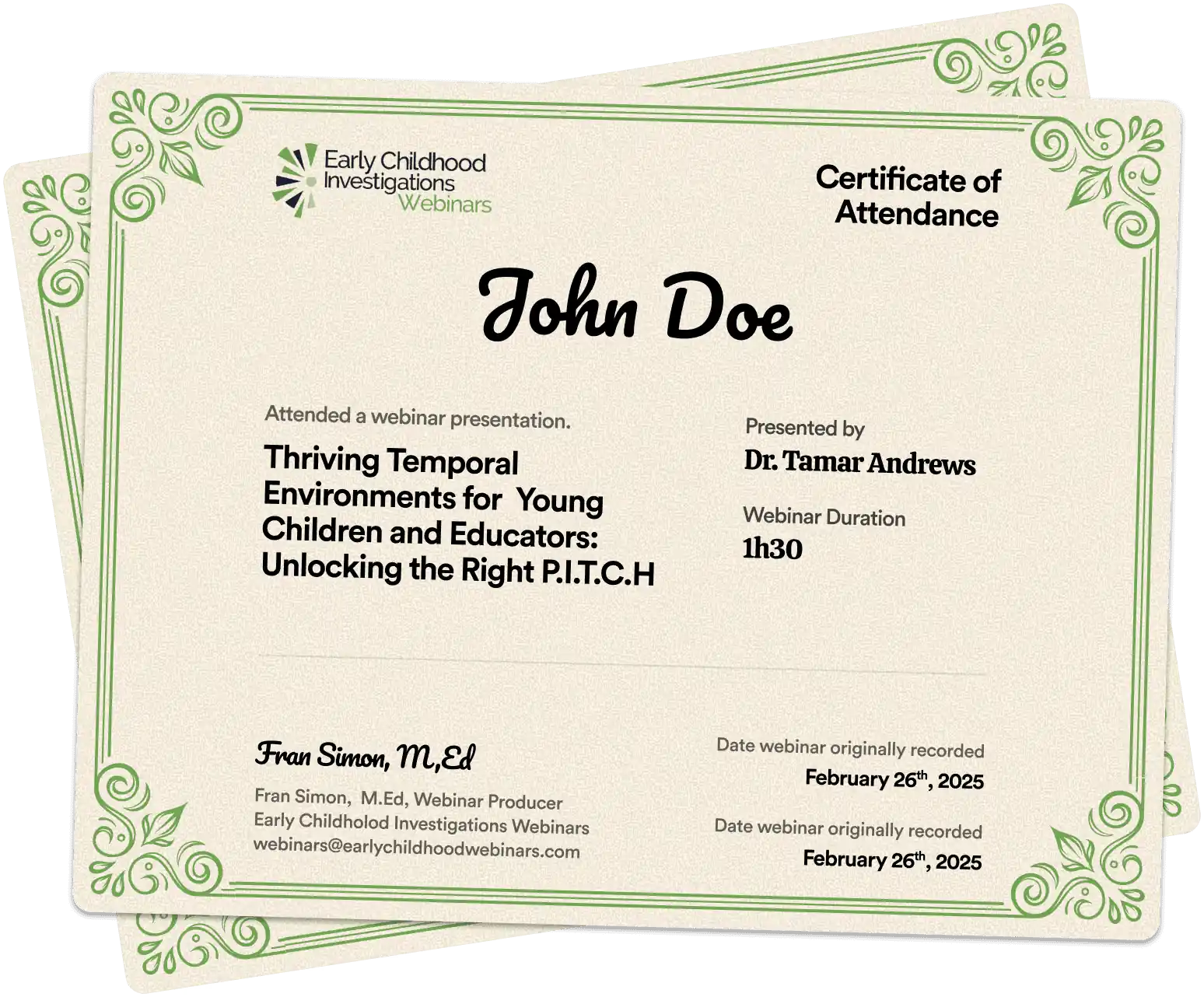
Attend the live webinar and stay from the beginning to the very end to automatically receive an official, personalized certificate by email within one week of the live webinar.
If you arrive late to the live webinar or watch the recording, you can download the blank certificate by entering the link announced and displayed at the end of the webinar into your browser.