
Thinking on Your Feet: Crisis Preparedness and Response in Inclusive Early Childhood Classrooms by Susan H Shapiro MS.Ed., Ed. D.
2 PM - 3:30 PM EST
Register for link

Resources
About this webinar
When an unexpected crisis disrupts the classroom, educators must make quick decisions, often with limited information and competing priorities. Whether responding to an emergency evacuation, a child's unexpected medical or sensory needs, or a crisis affecting families and the broader community, how can educators remain flexible, make informed decisions, and protect the well-being of every child?
Traditional emergency preparedness plans provide essential guidance, but they cannot anticipate every challenge, particularly in inclusive early childhood settings where children have diverse developmental, physical, sensory, and communication needs. Educators need more than established protocols; they need the confidence and critical-thinking skills to adapt their responses when circumstances change.
In this engaging webinar, Dr. Susan H. Shapiro will introduce the Education Crisis Framework (ECF), a practical approach to crisis decision-making that integrates immediate response, compassionate communication, and post-crisis recovery. Through real-world case studies and guided reflection, participants will explore the framework's Aviate, Communicate, Navigate model and its four reflective elements: Knowledge & Expertise, Community Compassion, Self-Compassion, and Community Impact.
Participants will examine how educators can make thoughtful decisions under pressure, respond to the individual needs of children and families, and support their communities through challenging situations. The session will also explore the importance of educator self-compassion and reflection in navigating the emotional demands of a crisis.
Join us to strengthen your ability to think flexibly, respond with confidence and compassion, and support safer, more resilient inclusive early childhood learning environments.
Learning Outcomes
By the end of this webinar, participants will be able to:
Identify key challenges and considerations when responding to crises involving young children with diverse developmental, physical, sensory, and communication needs in inclusive early childhood settings.
Apply the Education Crisis Framework's Aviate, Communicate, Navigate model to determine appropriate priorities and responses in hypothetical early childhood crisis scenarios.
Evaluate how the four reflective elements of the Education Crisis Framework—Knowledge & Expertise, Community Compassion, Self-Compassion, and Community Impact—inform crisis preparedness, decision-making, and post-crisis recovery.
Disclosure
Dr. Susan H. Shapiro is the author of the Education Crisis Framework (ECF) and receives royalties from her books, Crisis Leadership in Early Childhood Education: Lessons and Strategies for Leading Young Children Through Uncertainty and Developing Community-Based School Crisis Response: Case Studies for PreK–12 Classrooms, published by Routledge.
Upcoming Webinars
The Enrollment Hot Seat: A Live Marketing Workshop with Three Real Child Care Programs by Bruce Spurr
Nov 3, 2026

Boundaries vs. Requests: Setting Limits Without Escalation by Alyssa Blask Campbell
Nov 4, 2026

HuUbuntu: I Am Because We Are - Way of Life by Dr. Patrick Makokoro
Nov 5, 2026

Inspiring Terrific Toddlers 1: Why Do They Do That? Promoting Toddler Development to Reduce Frustrating Behaviors by Raelene Ostberg
Nov 11, 2026

When to Say When: Building Confidence in Supporting Neurodivergent and Developing Minds Part II: Direct Guidance, by Michele Hemenway Pullen
Nov 18, 2026
This is Your Brain on Fairytales: Storytelling, Neuroscience, and Connecting the Dots in Early Childhood by Stephanie Goloway
Nov 19, 2026

Hyperlocal Marketing: Turn Community Connections into Child Care Enrollment by Kate Woodward Young, M.Ed. and Carrie Casey
Dec 1, 2026

Talk, Play, Read, Sing: The Language Nutrition Approach to Creating Powerful Language Environments for Young Children by Jennifer Adams Oppenheimer
Dec 3, 2026

Ready for 2027? Need an Assistant? Let AI Help You Work Smarter by Monique Reynolds
Dec 8, 2026

Inspiring Terrific Toddlers 2: Evidence-Based Strategies to Set Effective Limits and Gain Gleeful Cooperation by Raelene Ostberg
Dec 9, 2026
Through the Child’s Eyes: Creating Responsive Classrooms Through Observation, Interaction, and Belonging by Lori Kowit, M.A.
Dec 10, 2026

Pause, Ponder, Play: The Power of Time in Nature-Based Learning by Dr. Rachel Larimore
Dec 16, 2026

Improving Young Children's Self-Regulation and Healthy Eating Habits: Four Core Guidance Strategies by Sarah Braaten, Ph.D.
Dec 17, 2026

Father Engagement in Early Childhood: Creating Programs Where Fathers Belong by Amanda Quiroz-Guajardo
Jan 6, 2027

Say It. Mean It. Support It.: Accountability That Builds People by Melissa Blotter
Jan 7, 2027

From Observation to Action: Using Documentation and Assessment to Guide Curriculum Planning by Cynthia Terebush, MS, BCISE, CYPFC
Jan 13, 2027

Learning Beyond the Fence: Safe and Meaningful Nature-Based Learning Outside the Fenced Play Area by Dr. Rachel Larimore
Jan 20, 2027
Transition Songs for Toddlers: How Music, Rhythm, and Melody Build Cooperation and Confidence by Cara Tyrrell
Jan 27, 2027

Thinking on Your Feet: Crisis Preparedness and Response in Inclusive Early Childhood Classrooms by Susan H Shapiro MS.Ed., Ed. D.
Jan 28, 2027

Developmental Screening vs. Assessment: Why Do Both? by Cynthia Terebush, MS, BCISE, CYPFC
Feb 3, 2027
From Screen Time to Time Together: The Power of Just Ten Minutes of Play, Music, and Connection by Anne Meeker Watson, PhD, MT-BC, and Jennifer Adams Oppenheimer, MA, CCC-SLP, BCS-CL
Feb 4, 2027

What's on Your Plate? Supporting Self-Regulation and Healthy Eating Through Family-Style Mealtimes by Sarah Braaten, Ph.D.
Feb 10, 2027
Playful and Engaging Math Instruction for Young Children by Deborah Stipek
Feb 17, 2027

Supporting Dual Language Learners: Building on Language, Culture, and Family Strengths by Amanda Quiroz-Guajardo
Feb 18, 2027
Compassionate Classroom Management: Words That Build Bonds and Boundaries by Cara Tyrrell
Feb 24, 2027
We're All Adults Here. So Why Is This So Hard? Navigating Workplace Conflict, Big Emotions, and Difficult Conversations by Alyssa Blask Campbell, M.Ed.
Mar 3, 2027

Frequently Asked Questions
How do I earn an official certificate?
Are there any prerequisites for attending a webinar?
Do you provide CEUs?
What is the format and learning environment of your live webinars?
How much does it cost to register for or attend a webinar?
How can I access an on-demand recording?
Can I earn a certificate by watching a recording?
How do I earn a certificate of attendance?
If I'm attending with a group, can we all earn a certificate of attendnace?
Free Certificates of Attendance
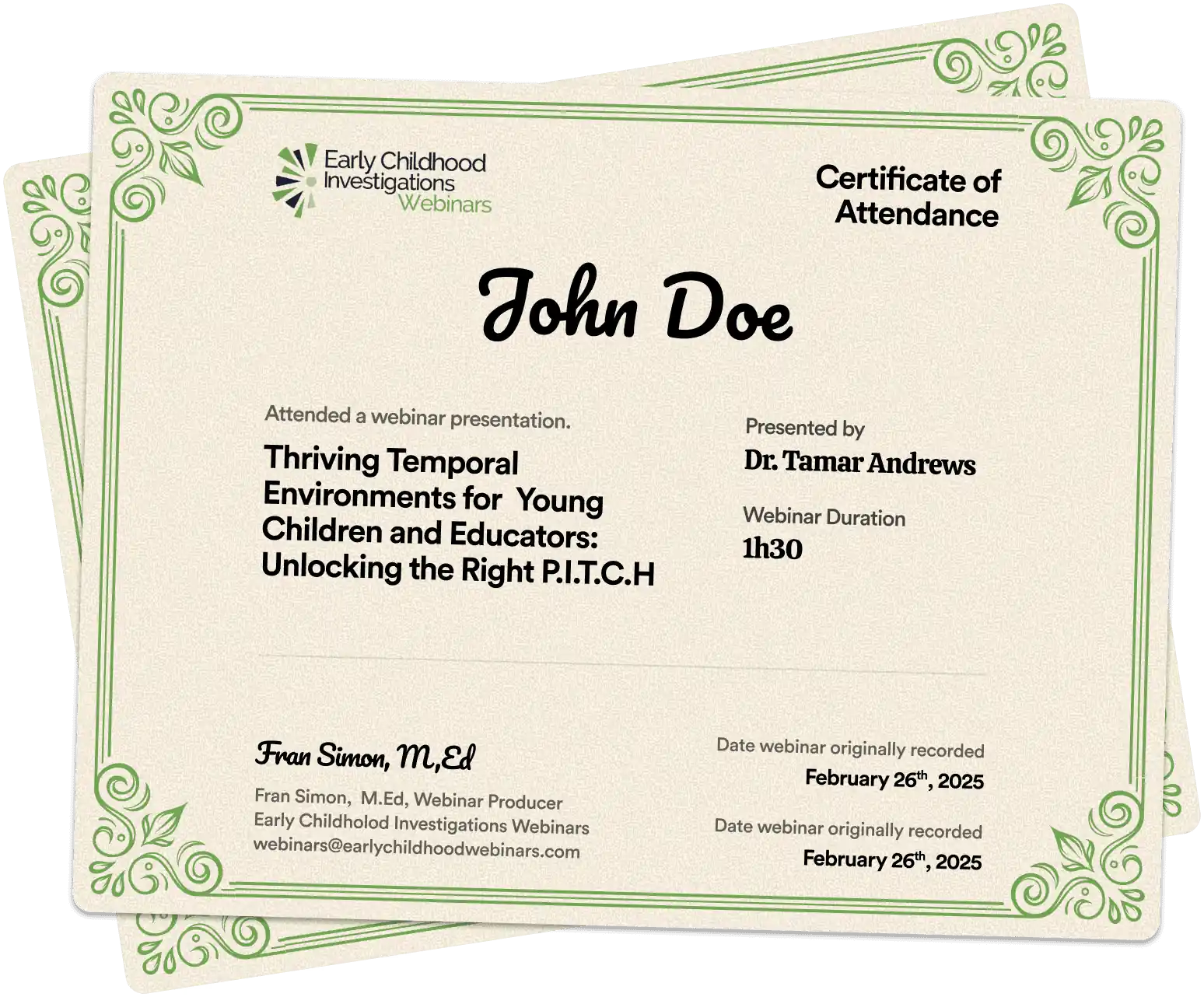
Attend the live webinar and stay from the beginning to the very end to automatically receive an official, personalized certificate by email within one week of the live webinar.
If you arrive late to the live webinar or watch the recording, you can download the blank certificate by entering the link announced and displayed at the end of the webinar into your browser.