
PLAYful Musical Environments That Foster Learning: Listening, Making, and Moving to Music in Early Education Settings, by Eric Rasmussen, Ph.D.
2 PM - 3:30 PM EST
Register for link

About this webinar
Sponsored by Kindermusik
as part of the Setting the Stage for a Lifetime of Learning Webinar Series
Music holds an exceptionally fascinating place in our development as human beings. Music is a part of EVERY culture no matter how remote. Children unlock their music potential best with playful and structured guidance of an early childhood music specialist, but because most early learning programs don’t have music specialists, child learning centers can easily borrow techniques from Master Music Educators.
Most music marketed for children is not of optimal quality especially in terms of production value and content. Just as children master their native tongue, they can also master music vocabulary by first simply listening- just as a newborns listens their families speak. Absorption of this "listening vocabulary" can provide children child-appropriate, diverse, and exemplary music in as many musical contexts, cultures and styles as possible. Our goal is to provide them with well-rounded diets of that include a buffet of everything children can digest—which is just about any genre or musical style- in addition to children’s’ music, that we can consider “dessert music”. The music we offer should be "nutritious" and appropriate, the limit being only that which you yourselves can model enjoyment by moving, dancing, and singing for the children. The earlier we start providing captivating musical experiences, the better.
We know the research: The first months of life through the early school age years are a period of exceptionally malleable neural growth. It is important to include music development during these stages.
In this extraordinary webinar, presented by Eric Rasmussen, Ph.D., the early childhood music department at the Peabody Preparatory of Johns Hopkins University, you will begin to understand the stages of early childhood music development and learn appropriate activities you can provide for children that best enhance their musicianship. We will answer questions such as:
What exercises are best to develop proper singing, movement, and rhythm vocabularies?
Why is a diverse repertoire of music important?
What is the value of breaking music down into small patterns?
What are some typical practices that can be inappropriate and may interfere with a child's music development?
What are three basic stages of music development that children move through before they sing in tune and move rhythmically?
How do children learn to crack the code of the adult music understanding world?
All sessions are 1.5 hours long, and include a brief announcement from our sponsor. 2:oo PM – 3:30 PM Eastern Time. To ensure you receive confirmation and reminder emails, add [email protected] to your contacts list. If you do not receive your email confirmation, check your Spam or Junk mail folders in your email system. Can’t participate in our webinars at the appointed time? Never fear! All of the webinars are recorded. To view the recording, simply register now and you will receive an email with a link to the recording when it is ready to be viewed. You can still download the certificate by watching the recording to the end when the certificate link is announced and displayed on the screen.
Only 1,000 people at one time can attend our webinars, but registration often tops 4,000. Only the first 1,000 people to click the link to attend the webinar will be able to get in. We start the webinars 30 minutes in advance of the start time. Arrive early to make sure you get in.
Please be advised that you will only be eligible for the great door prizes if you participate in the live session. You can earn .2 CEUs for each webinar. The cost is $15 paid to University of Oklahoma online when you apply. Learn more here: Continuing Education Units (CEUs) from University of Oklahoma See the schedule of upcoming webinars.
Upcoming Webinars
The Enrollment Hot Seat: A Live Marketing Workshop with Three Real Child Care Programs by Bruce Spurr
Nov 3, 2026

Boundaries vs. Requests: Setting Limits Without Escalation by Alyssa Blask Campbell
Nov 4, 2026
HuUbuntu: I Am Because We Are - Way of Life by Dr. Patrick Makokoro
Nov 5, 2026

Inspiring Terrific Toddlers 1: Why Do They Do That? Promoting Toddler Development to Reduce Frustrating Behaviors by Raelene Ostberg
Nov 11, 2026

When to Say When: Building Confidence in Supporting Neurodivergent and Developing Minds Part II: Direct Guidance, by Michele Hemenway Pullen
Nov 18, 2026
This is Your Brain on Fairytales: Storytelling, Neuroscience, and Connecting the Dots in Early Childhood by Stephanie Goloway
Nov 19, 2026

Hyperlocal Marketing: Turn Community Connections into Child Care Enrollment by Kate Woodward Young, M.Ed. and Carrie Casey
Dec 1, 2026

Talk, Play, Read, Sing: The Language Nutrition Approach to Creating Powerful Language Environments for Young Children by Jennifer Adams Oppenheimer
Dec 3, 2026

Ready for 2027? Need an Assistant? Let AI Help You Work Smarter by Monique Reynolds
Dec 8, 2026

Inspiring Terrific Toddlers 2: Evidence-Based Strategies to Set Effective Limits and Gain Gleeful Cooperation by Raelene Ostberg
Dec 9, 2026
Through the Child’s Eyes: Creating Responsive Classrooms Through Observation, Interaction, and Belonging by Lori Kowit, M.A.
Dec 10, 2026
Pause, Ponder, Play: The Power of Time in Nature-Based Learning by Dr. Rachel Larimore
Dec 16, 2026

Improving Young Children's Self-Regulation and Healthy Eating Habits: Four Core Guidance Strategies by Sarah Braaten, Ph.D.
Dec 17, 2026

Father Engagement in Early Childhood: Creating Programs Where Fathers Belong by Amanda Quiroz-Guajardo
Jan 6, 2027
Say It. Mean It. Support It.: Accountability That Builds People by Melissa Blotter
Jan 7, 2027

From Observation to Action: Using Documentation and Assessment to Guide Curriculum Planning by Cynthia Terebush, MS, BCISE, CYPFC
Jan 13, 2027

Learning Beyond the Fence: Safe and Meaningful Nature-Based Learning Outside the Fenced Play Area by Dr. Rachel Larimore
Jan 20, 2027
Transition Songs for Toddlers: How Music, Rhythm, and Melody Build Cooperation and Confidence by Cara Tyrrell
Jan 27, 2027

Developmental Screening vs. Assessment: Why Do Both? by Cynthia Terebush, MS, BCISE, CYPFC
Feb 3, 2027
From Screen Time to Time Together: The Power of Just Ten Minutes of Play, Music, and Connection by Anne Meeker Watson, PhD, MT-BC, and Jennifer Adams Oppenheimer, MA, CCC-SLP, BCS-CL
Feb 4, 2027
What's on Your Plate? Supporting Self-Regulation and Healthy Eating Through Family-Style Mealtimes by Sarah Braaten, Ph.D.
Feb 10, 2027
Playful and Engaging Math Instruction for Young Children by Deborah Stipek
Feb 17, 2027

Supporting Dual Language Learners: Building on Language, Culture, and Family Strengths by Amanda Quiroz-Guajardo
Feb 18, 2027
Compassionate Classroom Management: Words That Build Bonds and Boundaries by Cara Tyrrell
Feb 24, 2027
We're All Adults Here. So Why Is This So Hard? Navigating Workplace Conflict, Big Emotions, and Difficult Conversations by Alyssa Blask Campbell, M.Ed.
Mar 3, 2027

Frequently Asked Questions
How do I earn an official certificate?
Are there any prerequisites for attending a webinar?
Do you provide CEUs?
What is the format and learning environment of your live webinars?
How much does it cost to register for or attend a webinar?
How can I access an on-demand recording?
Can I earn a certificate by watching a recording?
How do I earn a certificate of attendance?
If I'm attending with a group, can we all earn a certificate of attendnace?
Free Certificates of Attendance
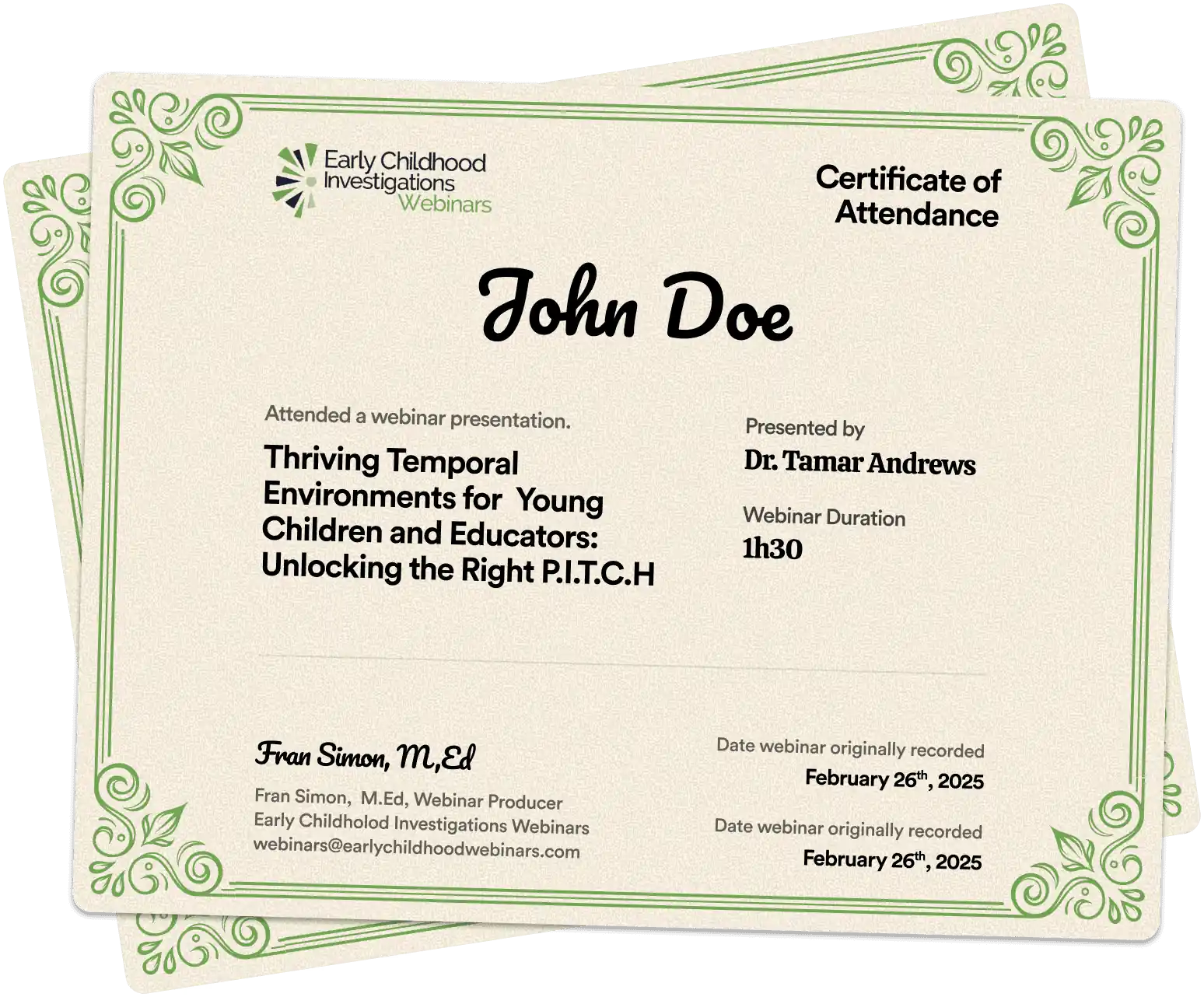
Attend the live webinar and stay from the beginning to the very end to automatically receive an official, personalized certificate by email within one week of the live webinar.
If you arrive late to the live webinar or watch the recording, you can download the blank certificate by entering the link announced and displayed at the end of the webinar into your browser.