
Storytelling’s Magic Wand: Developmental Fairydust for Literacy, Make-Believe, and Representational Thinking by Stephanie Goloway, EdD
2 PM - 3:30 PM EST
Register for link

Understanding Principles of Child Development and Learning
Child Development and Learning Theories
About this webinar
Imagine discovering that the key to unlocking the interwoven secrets of play, literacy, and even resilience can be found in the whimsical stories of young children—the ones they seem to conjure out of thin air as they transform snack crackers into hungry tigers and twigs into telephones. Guided by professor emerita of Early Education and Child Development Dr. Stephanie Goloway, this workshop invites you to explore how the magic in those flights of fancy builds the foundations for language, literacy, imagination, and more.
Sometimes referred to as representational thinking, a child’s growing ability to construct and play with symbols is one of the core developmental tasks of early childhood. Yet too often, we overlook the power of children’s make-believe as we focus on more concrete milestones on our developmental checklists. Dr. Goloway will help you examine the theory and neuroscience behind the development of representational thinking and reflect on how it emerges in young children’s play. You’ll connect the dots between storytelling, symbolic thinking, make-believe play, and emergent literacy.
Throughout the session, you’ll explore a variety of ways to wave the “magic wand” of storytelling in your setting—sharing folk and fairy tales, narrating creative movement experiences, and using quick anecdotes to scaffold transitions and routines. You’ll discover how, with each story you tell, you can nurture children’s capacity to transform their experiences into the wondrous web that underpins their play, reading, writing, problem-solving, and interactions with others.
The best part: the wild sense, curiosity, joy, and stories of young children will be truly honored and celebrated as you help them spin narratives and weave meaning into their world.
Participants will:
Define representational thinking in the context of early childhood development.
Explain the role of representational thinking and the use of symbols in emergent literacy and make-believe play.
Identify ways oral storytelling supports the development of representational thinking, literacy, and make-believe play.
Investigate how to incorporate different kinds of storytelling into any early childhood setting and schedule.
Examine the added benefits of telling folk and fairy tales to support representational thinking, emergent literacy, play, and resilience.
Upcoming Webinars
Website-First Marketing: The Simple Marketing System Every ECE Program Needs to Grow Online by Chelsea Denny
Oct 14, 2026

From First Tour to Long-Term Loyalty: Designing the Family & Staff Lifecycle Journey by Melissa Blotter
Oct 15, 2026

Preschoolers and Pixels by Amy Reyes-Hauff, CDHP
Oct 21, 2026

Our Voices Across Generations: AANHPI Educators in Early Childhood Education Panel
Oct 28, 2026

Boundaries vs. Requests: Setting Limits Without Escalation by Alyssa Blask Campbell
Nov 4, 2026

HuUbuntu: I Am Because We Are - Way of Life by Dr. Patrick Makokoro
Nov 5, 2026

Inspiring Terrific Toddlers 1: Why Do They Do That? Promoting Toddler Development to Reduce Frustrating Behaviors by Raelene Ostberg
Nov 11, 2026

When to Say When: Building Confidence in Supporting Neurodivergent and Developing Minds Part II: Direct Guidance, by Michele Hemenway Pullen
Nov 18, 2026
This is Your Brain on Fairytales: Storytelling, Neuroscience, and Connecting the Dots in Early Childhood by Stephanie Goloway
Nov 19, 2026

Talk, Play, Read, Sing: The Language Nutrition Approach to Creating Powerful Language Environments for Young Children by Jennifer Adams Oppenheimer
Dec 3, 2026

Inspiring Terrific Toddlers 2: Evidence-Based Strategies to Set Effective Limits and Gain Gleeful Cooperation by Raelene Ostberg
Dec 9, 2026
Through the Child’s Eyes: Creating Responsive Classrooms Through Observation, Interaction, and Belonging by Lori Kowit, M.A.
Dec 10, 2026
Pause, Ponder, Play: The Power of Time in Nature-Based Learning by Dr. Rachel Larimore
Dec 16, 2026

Learning Beyond the Fence: Safe and Meaningful Nature-Based Learning Outside the Fenced Play Area by Dr. Rachel Larimore
Jan 20, 2027
Frequently Asked Questions
How do I earn an official certificate?
Are there any prerequisites for attending a webinar?
Do you provide CEUs?
What is the format and learning environment of your live webinars?
How much does it cost to register for or attend a webinar?
How can I access an on-demand recording?
Can I earn a certificate by watching a recording?
How do I earn a certificate of attendance?
If I'm attending with a group, can we all earn a certificate of attendnace?
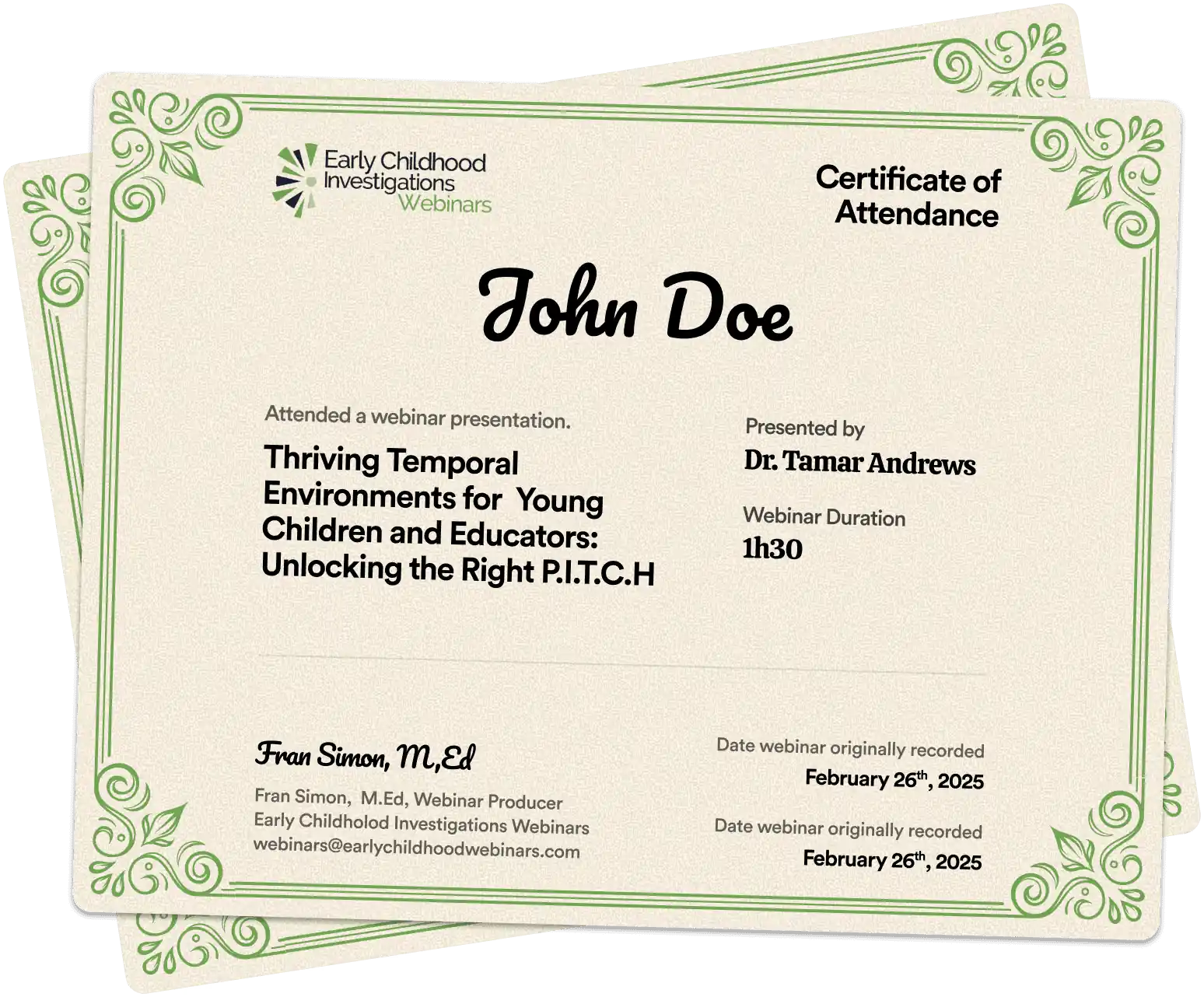
Free Certificates of Attendance
Attend the live webinar and stay from the beginning to the very end to automatically receive an official, personalized certificate by email within one week of the live webinar.
If you arrive late to the live webinar or watch the recording, you can download the blank certificate by entering the link announced and displayed at the end of the webinar into your browser.