
How Teachers Can Teach Without Taking Over: Scaffolding Learning in Preschool Classrooms by Amy Chiu, MSEd
2 PM - 3:30 PM EST
Register for link

About this webinar
What does it really mean to support children’s learning without doing the work for them?
In this session, presented by early childhood consultant Amy Chiu, M.Ed., from The Work of Play, you’ll explore the art and practice of scaffolding - one of the most essential tools in early childhood education. Scaffolding helps bridge the space between what a child can do independently and what they can accomplish with guidance. But it’s more than a strategy - it’s a mindset rooted in trust, observation, and responsiveness.
You’ll be invited to reflect on how you offer help: When is it supportive? When might it unintentionally take over the learning process? Through vivid examples from real classrooms and common parenting experiences, you’ll see how scaffolding can empower children to become confident and persistent problem-solvers.
We’ll explore how observation, timing, and gentle prompts allow you to provide “just enough” support - nurturing both competence and independence. You’ll also consider common pitfalls of over-helping and how to shift into a facilitation role that honors children's voice and agency.
Whether you’re a teacher, parent, instructional coach, or administrator, this session will give you concrete tools and language to elevate your practice. Most importantly, it will reframe scaffolding not as something you do to children, but as a way of being with them as they grow.
Join this session to learn to:
Define scaffolding and explain its importance in early learning and development.
Identify the difference between teaching and taking over.
Apply scaffolding strategies that support independence, confidence, and problem-solving.
Reflect on their own adult role in moments of struggle or learning discomfort.
Use observation and timing to decide when to step in - and when to step back.
Upcoming Webinars
Inspiring Terrific Toddlers 1: Why Do They Do That? Promoting Toddler Development to Reduce Frustrating Behaviors by Raelene Ostberg
Nov 11, 2026

When to Say When: Building Confidence in Supporting Neurodivergent and Developing Minds Part II: Direct Guidance, by Michele Hemenway Pullen
Nov 18, 2026
This is Your Brain on Fairytales: Storytelling, Neuroscience, and Connecting the Dots in Early Childhood by Stephanie Goloway
Nov 19, 2026

Hyperlocal Marketing: Turn Community Connections into Child Care Enrollment by Kate Woodward Young, M.Ed. and Carrie Casey
Dec 1, 2026

Talk, Play, Read, Sing: The Language Nutrition Approach to Creating Powerful Language Environments for Young Children by Jennifer Adams Oppenheimer
Dec 3, 2026

Ready for 2027? Need an Assistant? Let AI Help You Work Smarter by Monique Reynolds
Dec 8, 2026

Inspiring Terrific Toddlers 2: Evidence-Based Strategies to Set Effective Limits and Gain Gleeful Cooperation by Raelene Ostberg
Dec 9, 2026
Through the Child’s Eyes: Creating Responsive Classrooms Through Observation, Interaction, and Belonging by Lori Kowit, M.A.
Dec 10, 2026

Pause, Ponder, Play: The Power of Time in Nature-Based Learning by Dr. Rachel Larimore
Dec 16, 2026

Improving Young Children's Self-Regulation and Healthy Eating Habits: Four Core Guidance Strategies by Sarah Braaten, Ph.D.
Dec 17, 2026

Father Engagement in Early Childhood: Creating Programs Where Fathers Belong by Amanda Quiroz-Guajardo
Jan 6, 2027
Say It. Mean It. Support It.: Accountability That Builds People by Melissa Blotter
Jan 7, 2027

From Observation to Action: Using Documentation and Assessment to Guide Curriculum Planning by Cynthia Terebush, MS, BCISE, CYPFC
Jan 13, 2027

Learning Beyond the Fence: Safe and Meaningful Nature-Based Learning Outside the Fenced Play Area by Dr. Rachel Larimore
Jan 20, 2027
Tantrums, Tears, and Tough Moments: Rethinking How We Respond to Young Children by Claire Lerner, LICSW
Jan 21, 2027

Transition Songs for Toddlers: How Music, Rhythm, and Melody Build Cooperation and Confidence by Cara Tyrrell
Jan 27, 2027

Thinking on Your Feet: Crisis Preparedness and Response in Inclusive Early Childhood Classrooms by Susan H. Shapiro, MS.Ed., Ed. D.
Jan 28, 2027

Developmental Screening vs. Assessment: Why Do Both? by Cynthia Terebush, MS, BCISE, CYPFC
Feb 3, 2027
From Screen Time to Time Together: The Power of Just Ten Minutes of Play, Music, and Connection by Anne Meeker Watson, PhD, MT-BC, and Jennifer Adams Oppenheimer, MA, CCC-SLP, BCS-CL
Feb 4, 2027

What's on Your Plate? Supporting Self-Regulation and Healthy Eating Through Family-Style Mealtimes by Sarah Braaten, Ph.D.
Feb 10, 2027
Playful and Engaging Math Instruction for Young Children by Deborah Stipek
Feb 17, 2027

Supporting Dual Language Learners: Building on Language, Culture, and Family Strengths by Amanda Quiroz-Guajardo
Feb 18, 2027
Compassionate Classroom Management: Words That Build Bonds and Boundaries by Cara Tyrrell
Feb 24, 2027
We're All Adults Here. So Why Is This So Hard? Navigating Workplace Conflict, Big Emotions, and Difficult Conversations by Alyssa Blask Campbell, M.Ed.
Mar 3, 2027

Frequently Asked Questions
How do I earn an official certificate?
Are there any prerequisites for attending a webinar?
Do you provide CEUs?
What is the format and learning environment of your live webinars?
How much does it cost to register for or attend a webinar?
How can I access an on-demand recording?
Can I earn a certificate by watching a recording?
How do I earn a certificate of attendance?
If I'm attending with a group, can we all earn a certificate of attendnace?
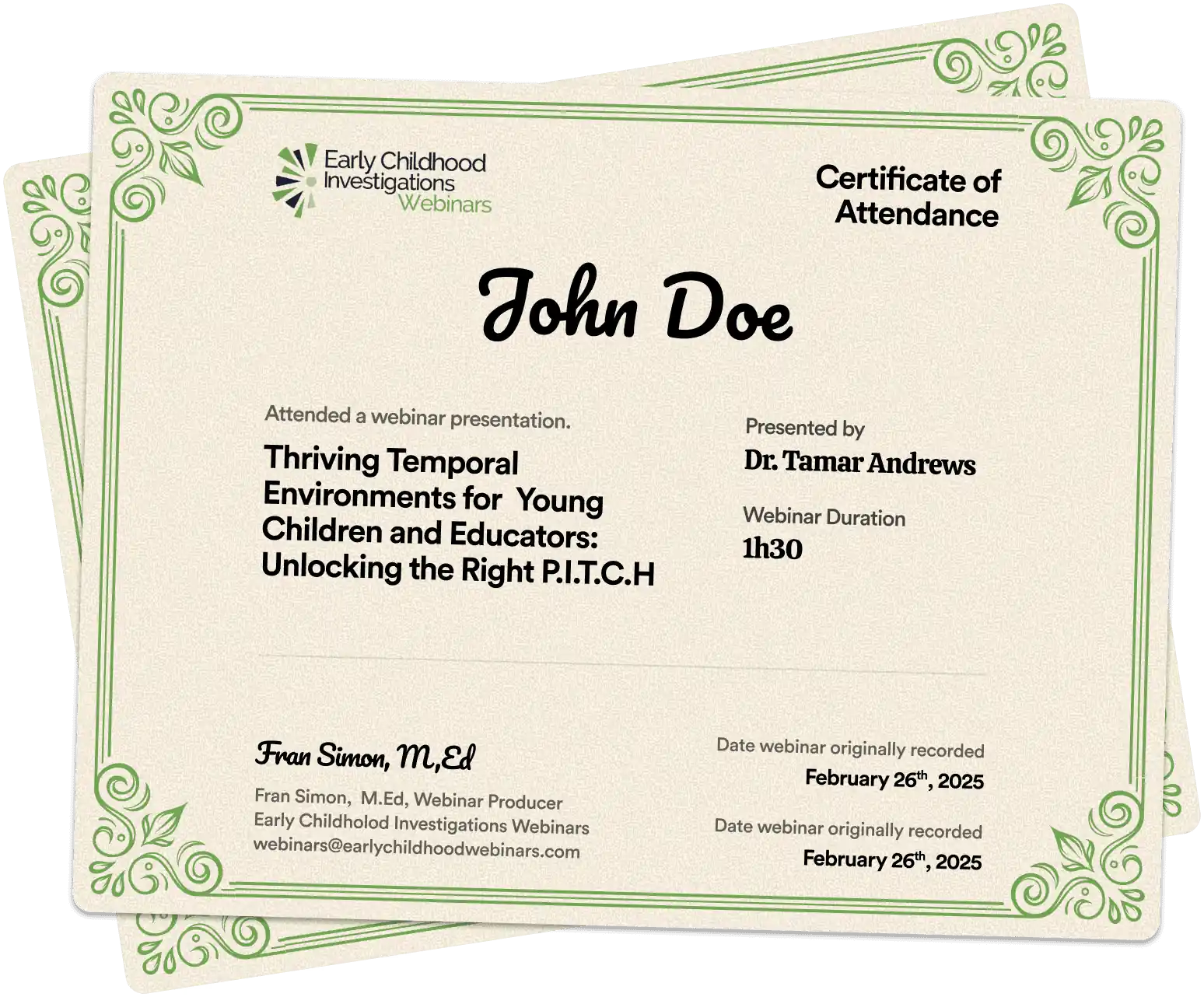
Free Certificates of Attendance
Attend the live webinar and stay from the beginning to the very end to automatically receive an official, personalized certificate by email within one week of the live webinar.
If you arrive late to the live webinar or watch the recording, you can download the blank certificate by entering the link announced and displayed at the end of the webinar into your browser.